Create a tree from an STGrid object
# S4 method for STGrid
hc_tree(
  object,
  method = c("complete", "ward.D", "ward.D2", "single", "average", "mcquitty", "median",
    "centroid"),
  layout = c("circular", "rectangular", "slanted", "fan", "unrooted", "time-scale",
    "two-dimensional"),
  dist_method = "pearson",
  branch_length = "none",
  class_nb = 1,
  class_name = NULL,
  size = 2.25,
  colors = NULL,
  class_label = TRUE,
  offset = 5,
  offset.text = 1.5,
  lab_fontsize = 3.88,
  lab_barsize = 2,
  geom_label = c("text", "label", "shadowtext"),
  no_legend = FALSE,
  return_tree = FALSE
)
Arguments
- object
The STGrid object
- method
The agglomeration method to be used. See stats::hclust().
- layout
The layout to be used See ggtree::ggtree().
- dist_method
The method for distance computation. See stats::cor().
- branch_length
A variable for scaling branch, if 'none' draw cladogram. See ggtree::ggtree().
- class_nb
An integer indicating the desired number of groups.
- class_name
A set of names for the classes.
- size
The size of the labels.
- colors
A set of colors for the classes.
- class_label
Whether to add class labels.
- offset
Offset of labels from the clade
- offset.text
Offset of text labels from the bar.
- lab_fontsize
Label font size.
- lab_barsize
Bar label size.
- geom_label
Label fomat.
- no_legend
Whether to discard legend.
- return_tree
Logical. Whether to return the tree not the plot. In fact a list with the tree and associated clusters.
Examples
example_dataset()
#> |-- INFO : Dataset 11284233/files/Xenium_Mouse_Brain_Coronal_7g was already loaded.
p <- hc_tree(Xenium_Mouse_Brain_Coronal_7g, class_nb = 4, class_name = letters[1:4])
#> |-- INFO : Using complete method
#> |-- INFO : Using circular layout
print(p)
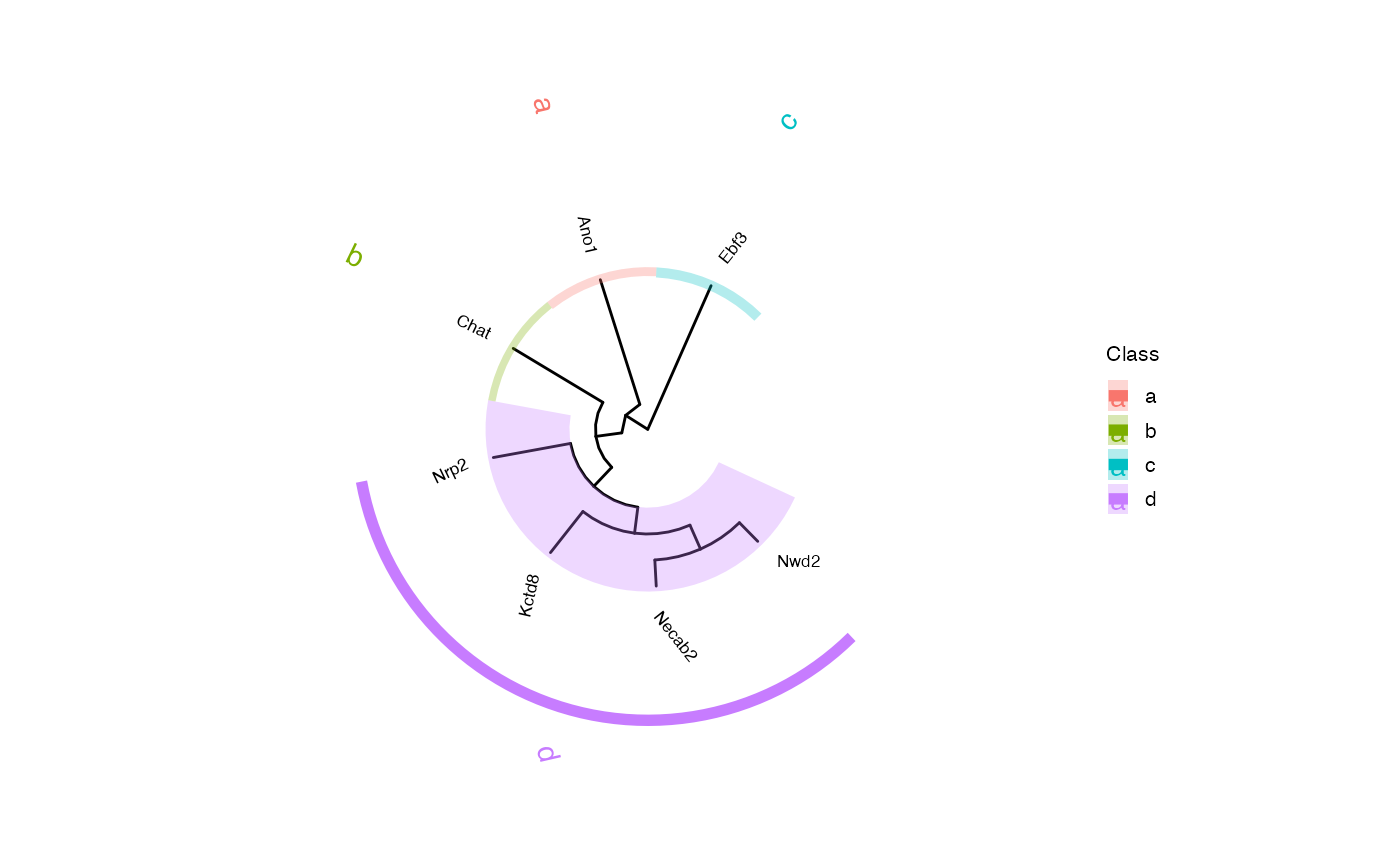 # Get classes:
p$tree_classes
#> $MOD1
#> [1] "Ano1"
#>
#> $MOD2
#> [1] "Chat"
#>
#> $MOD3
#> [1] "Ebf3"
#>
#> $MOD4
#> [1] "Kctd8" "Necab2" "Nrp2" "Nwd2"
#>
# Get classes:
p$tree_classes
#> $MOD1
#> [1] "Ano1"
#>
#> $MOD2
#> [1] "Chat"
#>
#> $MOD3
#> [1] "Ebf3"
#>
#> $MOD4
#> [1] "Kctd8" "Necab2" "Nrp2" "Nwd2"
#>